|
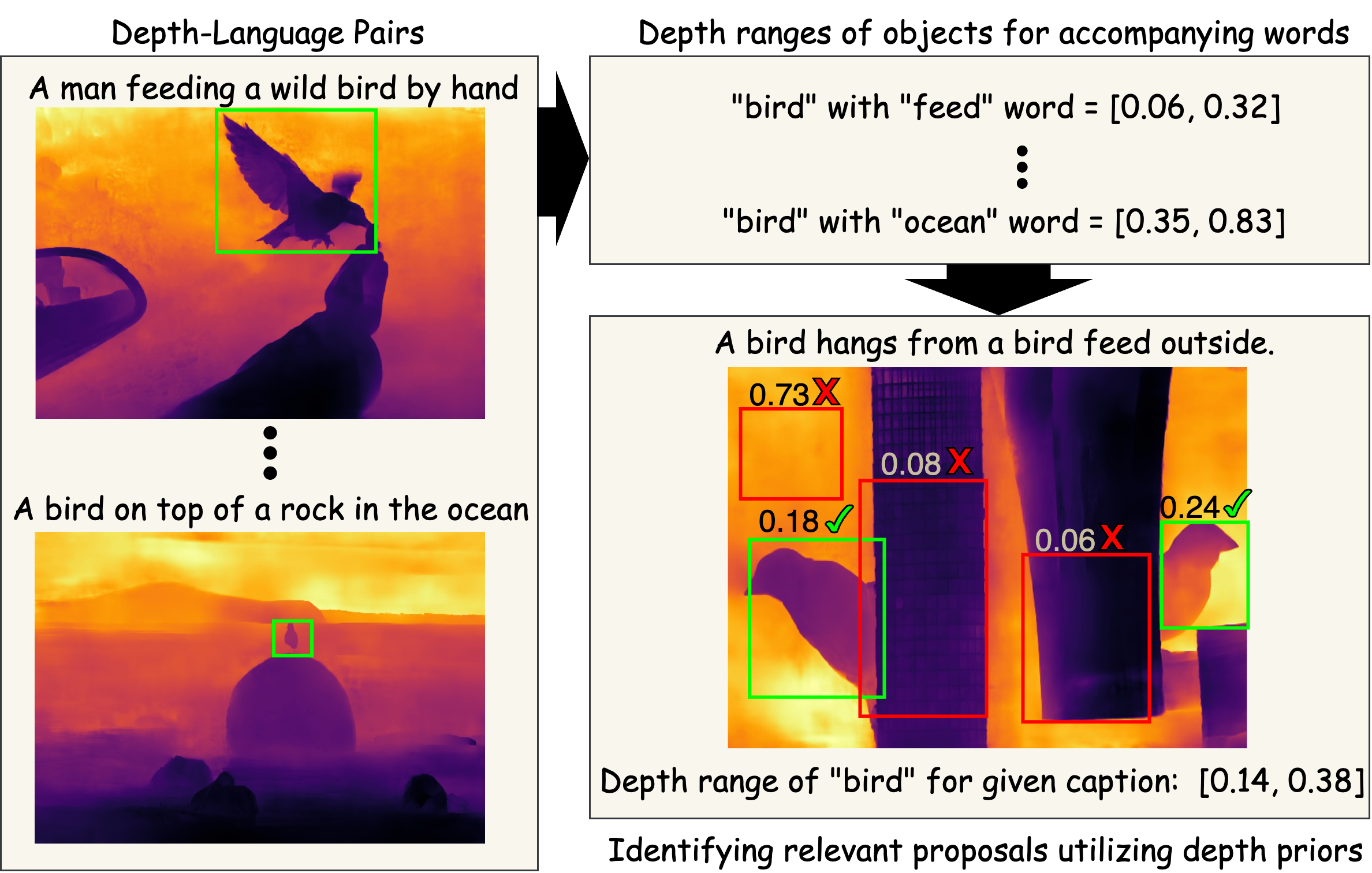
Despite recent attention to depth for various tasks, it is still an unexplored modality for weakly-supervised object detection (WSOD). We propose an amplifier method for enhancing the performance of WSOD by integrating depth information. Our approach can be applied to different WSOD methods based on multiple-instance learning, without necessitating additional annotations or inducing large computational cost. Our proposed method employs monocular depth estimation to obtain hallucinated depth information, which is then incorporated into a Siamese WSOD network using contrastive loss and fusion. By analyzing the relationship between language context and depth, we calculate depth priors to identify the bounding box proposals that may contain an object of interest. These depth priors are then utilized to update the list of pseudo ground-truth boxes, or adjust the confidence of per-box predictions. We evaluate our proposed method on three datasets (COCO, PASCAL VOC, and Conceptual Captions) by implementing it on top of two state-of-the-art WSOD methods, and we demonstrate a substantial enhancement in performance. |